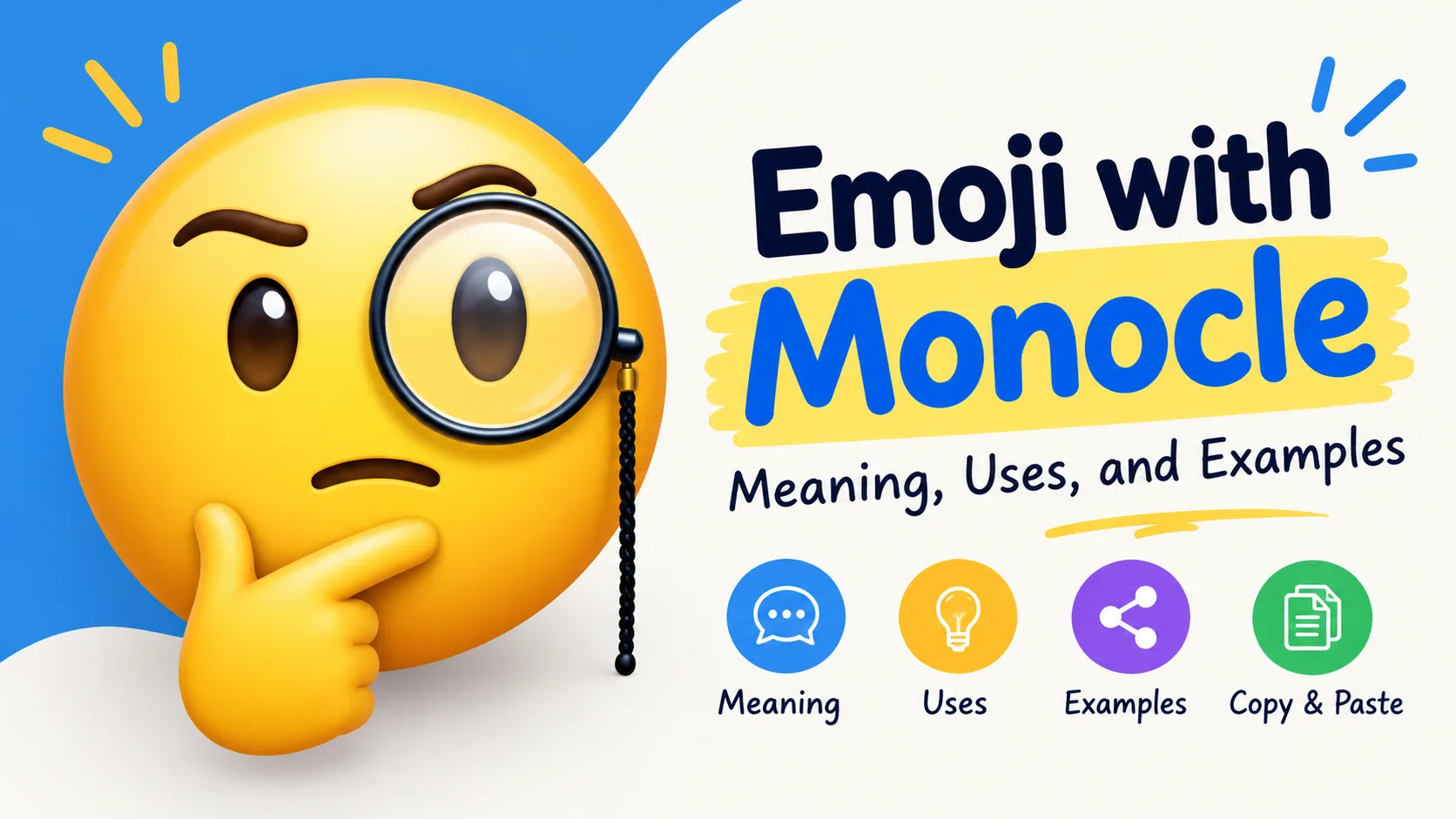
You’ve seen it in group chats, comment sections, and replies to questionable claims: a yellow face, one raised eyebrow, and a tiny monocle over one eye. The emoji with monocle 🧐 can say “let me take a closer look,” “I’m not so sure about that,” or “how very fancy of you,” all without a single word.
That’s what makes it so interesting and a little tricky. Depending on the context, the monocle emoji can sound curious, sarcastic, smug, or sophisticated. Send it at the wrong moment and your message may land very differently than you meant it.
In this guide, we’ll break down what the monocle emoji really means, where it came from, how to use it, how it looks across platforms, and which emojis get mistaken for it. By the end, you’ll know exactly when 🧐 is the perfect reaction.
Quick Facts Snapshot
| Emoji | 🧐 |
| Official name | Face with Monocle |
| Unicode code point | U+1F9D0 |
| Category | Smileys & Emotion, in the face-glasses subgroup |
| Released | Unicode 10.0 and Emoji 5.0, both dated June 20, 2017 |
| Official keywords | face, stuffy, wealthy, face with monocle |
| HTML entity | 🧐 |
| CSS | \1F9D0 |
| JavaScript | \u{1F9D0} |
| Python | \U0001F9D0 |
| Copy and paste | 🧐 🧐 is Face With Monocle Emoji +3 |
What Is the Emoji with Monocle?
The emoji with monocle, officially called Face with Monocle, is a yellow smiley face wearing a single eyeglass over one eye. It is usually drawn with furrowed eyebrows, a small frown, and a slightly upturned head, as if the face is inspecting something carefully. The overall effect is part detective, part aristocrat.
It also goes by a few informal names, such as the monocle emoji, monocle face, or simply the fancy emoji. Official emoji data tags it with the words “stuffy” and “wealthy,” which hints at the posh, old-money humor many people associate with it.
Why It Stands Out
Most emojis with eyewear, like 😎 (sunglasses) or 🤓 (nerd face), wear a pair of glasses and look straightforward. The monocle gives 🧐 a more theatrical personality. A single magnified eye suggests someone is studying something closely, and the raised brow adds a hint of doubt or judgment.
What It Usually Signals
- Inspection and curiosity: “Let me look at this more closely.”
- Skepticism: “Is that really true?”
- Mock sophistication: playing the fancy gentleman or lady.
- Smug intelligence: a “well, actually” attitude.
A Quick Origin Note
The emoji arrived as part of a batch of new emojis in 2017, so it’s now available on all major platforms and should display properly on almost any modern phone, computer, or app.
What Does the Monocle Emoji Mean?
The monocle emoji has no single meaning. Its message shifts with the sentence around it, but nearly every use falls into a handful of categories.
The Main Meanings
1. Curiosity and close inspection
The most common use is to signal scrutiny, as if something deserves a closer look. It works like a magnifying glass in emoji form.
Example: “Wait, did they just change the logo? 🧐”
2. Skepticism and doubt
The emoji acts almost like a digital raised eyebrow, telling the other person you’ve noticed something that doesn’t quite add up.
Example: “He says he’ll be there on time 🧐”
3. Sophistication and “fancy” humor
Some people use it to convey a posh attitude, leaning into the old-money aesthetic or vintage humor. It’s the go-to emoji for pretending to be refined.
Example: “Dinner tonight is cereal, served in a wine glass 🧐”
4. Smug intelligence
It can also suggest a sense of smug intelligence, the classic “smarty-pants” energy. Sending it after pointing out a small mistake is a good example.
5. Detective-style investigation
When something seems suspicious, 🧐 puts you in the role of a sleuth examining the evidence.
Example: “Interesting timing for that announcement 🧐”
Tone and Context
The same emoji can read as friendly or biting, depending on the situation.
- Sincere: genuine interest, as in “Show me the details 🧐”
- Playful: teasing a friend, as in “Oh, so you’re an expert now 🧐”
- Sarcastic: often used ironically, such as pretending to be classy while drinking cheap wine meetedgar
- Passive-aggressive: a polite-looking reaction that quietly questions someone’s claim
Three things shape how it lands:
- Surrounding text. A question mark makes it curious. A flat statement makes it judgmental.
- Your relationship. Between friends it’s a joke. With a boss or stranger it can feel condescending.
- The platform. Different designs look friendlier or sterner, which we’ll cover in a later section.
Different Communities, Different Uses
Usage tends to vary by space:
- Meme and commentary culture: popular in memes where someone “evaluates” a statement, post, or choice meetedgar
- Fandoms and gaming: analyzing a plot twist, a patch note, or a questionable strategy
- Work and professional chats: used sparingly, usually to signal “I’ll look into this,” though it risks sounding doubtful
- Everyday texting: quick reactions to gossip, claims, or odd news
Age groups and communities don’t always read it the same way. Some see it as a harmless “hmm,” others as clearly sarcastic. Treat it as a tone that depends on context rather than a fixed code.
Fun Facts and Trivia
1. Its official keywords are cheeky. Emoji data tags the monocle face with the words “stuffy” and “wealthy,” which explains its posh, old-money reputation.
2. It was requested by users. Unicode’s subcommittee ranked new faces using popularity data from Facebook, Skype, and EmojiXpress, and a monocle face showed up in that data.
3. It has a birthday. Both Unicode 10.0 and Emoji 5.0 are dated June 20, 2017.
4. People predicted its fame early. A 2017 article on emoji popularity asked whether the monocle face might become the next tears-of-joy face, a bold guess for a newcomer. It hasn’t taken that crown, but it has found a devoted niche.
5. It’s machine-friendly too. In UTF-8 it is stored as four bytes (F0 9F A7 90), and in UTF-16 as the pair D83E DDD0. Developers can paste it into code without trouble.
6. It belongs to a famous crowd. The monocle has long marked fictional gentlemen like Mr. Peanut and Eustace Tilley, so the emoji borrows a lot of cultural baggage.
7. It’s often mistaken for a nerd or thinking face. The monocle is more theatrical: it examines rather than wonders.
8. It plays well with irony. People often use it to pretend to be classy while doing something decidedly unfancy.
Common Mistakes and Misunderstandings
Even a simple emoji can cause confusion. Here are the most common slip-ups with 🧐 and how to avoid them.
1. Using It When You Meant 🤔
The thinking face shows honest uncertainty, while the monocle examines something with attitude. If you just want to say “I’m not sure what to do,” 🤔 is the safer choice.
2. Sounding Sarcastic by Accident
The monocle acts like a digital raised eyebrow, so it can imply doubt even when you meant to be curious. Add a few clarifying words, such as “Interesting, tell me more 🧐.”
3. Coming Across as Condescending
The emoji’s “smug intelligence” side can feel like talking down to someone, especially after they’ve shared an idea, a mistake, or a personal story. Skip it in those moments.
4. Sending It in Serious Conversations
Because it’s playful and a little mocking, 🧐 doesn’t suit sensitive topics such as bad news, grief, or conflict.
5. Ignoring Platform Differences
A design that looks friendly on your phone may look stern on someone else’s, which can change how your message feels.
6. Overusing or Stacking It
One 🧐 is a raised eyebrow. A row of them reads as exaggerated sarcasm.
7. Misreading Cross-Cultural Context
Emoji tone varies between communities, ages, and cultures. A joking monocle among close friends may look rude to someone you’ve just met.
The Safe Approach
Pair it with clear text, match it to your relationship, and when in doubt, choose a friendlier emoji.
Frequently Asked Questions
What does the emoji with monocle mean?
It usually shows that someone is pondering, questioning, or inviting a closer look at something, and it can also convey skeptical or ironic observation or smug intelligence.
Is 🧐 sarcastic or serious?
It can be either. Sincere curiosity and playful sarcasm both fit, so the surrounding text and your relationship with the reader decide the tone.
What’s the difference between 🧐 and 🤔?
The thinking face signals genuine uncertainty. The monocle examines or judges something, often with a touch of mock sophistication.
When was the monocle emoji added?
It arrived in Unicode 10.0 and Emoji 5.0, both dated June 20, 2017.
Is the monocle emoji available on all devices?
Because it has been around for years, it should display correctly on the majority of operating systems. If it looks like a blank box, updating your device or app usually fixes it.
Can I use it in professional emails?
Sparingly. It can read as doubt or condescension, so avoid it with clients, managers, or people you don’t know well. Use a neutral emoji or plain text instead.
What’s the Unicode for the monocle emoji?
The code point is U+1F9D0.
Is it also called the “fancy” emoji?
Informally, yes. Its official keywords include “stuffy” and “wealthy,” which is why many people link it to a posh, old-money look.
Conclusion
The emoji with monocle 🧐 packs a surprising amount of personality into one small face. It can show curiosity, raise a doubtful eyebrow, play the posh gentleman, or deliver a perfectly timed “well, actually.” Its meaning depends on context, which is exactly what makes it so fun and so easy to misread.
Here’s what to remember:
- Meaning: scrutiny, skepticism, sophistication, and smug intelligence.
- Origin: it arrived with Unicode 10.0 and Emoji 5.0 in 2017, and carries the cultural baggage of aristocrats and detectives.
- Usage: it’s best for playful reactions and light teasing, and riskier in serious or professional settings.
- Look-alikes: choose 🤔 for real uncertainty, 🤨 for blunt doubt, 🤓 for playful smarts, and 🧐 when you want to scrutinize with style.
- Platforms: designs vary, so add a few clear words when tone matters.
Next time something looks a little suspicious, a little fancy, or deserves a second glance, you’ll know exactly when to reach for 🧐.
What’s your favorite way to use the monocle emoji? Share it in the comments, and check out our other emoji guides to keep exploring.

Hi, I’m Benjamin Dreyer. 😊 I enjoy exploring the world of emojis and digital communication, making emoji meanings and expressions simple to understand. At Defineexa.com, I write about emojis, their meanings, text abbreviations, acronyms, and internet slang. My goal is to provide clear, accurate, and easy-to-read explanations that help readers understand what different emojis and online expressions mean, how they’re used, and how they can communicate with confidence in everyday conversations. 💬