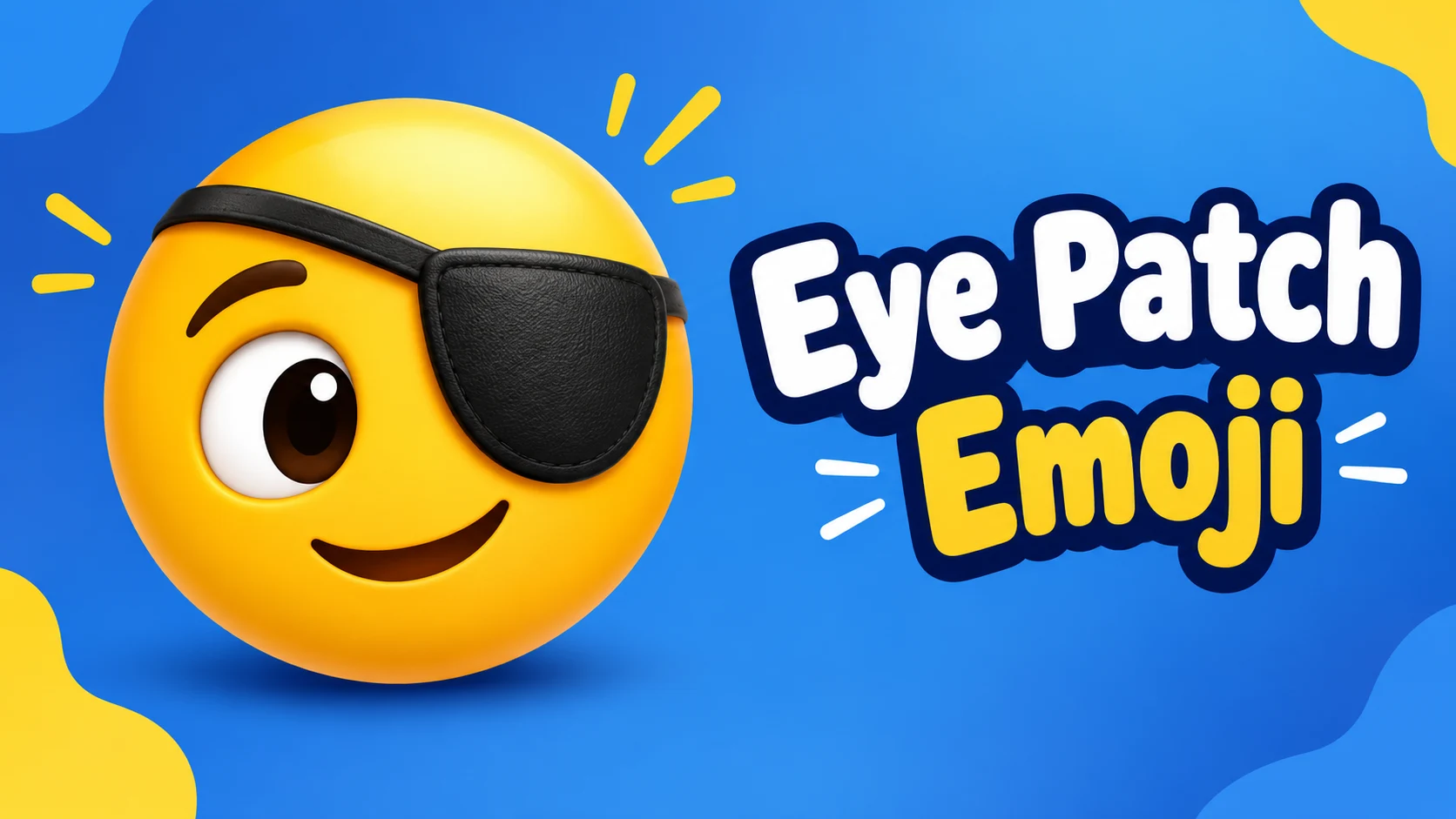
You’re texting a friend about your pirate costume, or joking about squinting through a tough morning, and you reach for the perfect emoji. You scroll. And scroll. Nothing. There’s a pirate flag, a parrot, even a face with a monocle, but no eye patch.
So, is there an eye patch emoji? As far as I can tell, not yet. With thousands of emoji on our keyboards, it’s a surprising gap for something so instantly recognizable.
In this article, we’ll look at why the eye patch emoji is missing, which existing emoji come closest, how Unicode decides what makes the cut, and how you can help get one approved. Plus, you’ll get some handy workarounds to use right now.
What People Actually Mean by “Eye Patch Emoji”
Search for an eye patch emoji and you’ll find people want it for very different reasons. That’s part of what makes it tricky.
The pirate look. For most people, an eye patch means one thing: a pirate. It’s the go-to shorthand for Halloween costumes, themed parties, and playful “arr, matey” captions.
The medical meaning. An eye patch is also a real, practical item. People wear them while recovering from eye surgery or injury, and they’re sometimes used in vision treatment. For them, an emoji could be a simple way to say, “I’m healing.”
The style statement. In games, anime, and fantasy stories, an eye patch signals a tough, mysterious character. Fans and gamers would likely use it to show attitude, not piracy.
The joke or metaphor. Sometimes it’s just humor, like “keeping one eye on things” or “I’m barely awake.”
Four very different uses, one missing emoji. That mix of broad appeal is exactly the kind of argument that matters when you’re asking Unicode for something new, which we’ll get to shortly.
A Brief History of the Eye Patch
The eye patch is far older than any emoji keyboard, and its story is more practical than the pirate image suggests.
A medical tool first. People have covered injured or diseased eyes for a very long time, simply to protect them and help them heal. Today, patches are still used after eye surgery and injury, and in treating conditions like a “lazy eye,” where covering the stronger eye helps train the weaker one.
War and everyday life. Eye injuries were common in battle and in dangerous trades, so patches became familiar. Over time, some people also wore them as a style statement.
Enter the pirate. The image we know best was built largely by books, stage plays, and movies. Fictional swashbucklers with a patch, a parrot, and a pirate flag became so iconic that the patch is now almost a symbol of piracy itself.
Myth vs. reality. You’ll often hear that pirates wore patches so one eye would already be adjusted to darkness when they went below deck. It’s a fun, plausible-sounding theory, but there’s little solid historical evidence that it was common practice. Treat it as a popular legend, not established fact.
Why this matters for emoji. Because pop culture made the pirate meaning dominant, an eye patch emoji would likely be read as “pirate” first. That’s useful for Halloween posts, but it could overshadow the medical and style meanings, a tension that comes up again when we look at design choices.
What’s on the Keyboard Today
While there’s no eye patch emoji, a handful of existing ones can stand in. Some capture the pirate vibe, some the medical side, and some just the “one eye” idea. None does all three.
Pirate stand-ins. The pirate flag 🏴☠️ is the obvious pick, and the parrot 🦜 and anchor ⚓ help set the scene. But they signal “pirate” without showing the patch itself.
Face and eye emoji. Sunglasses 😎 give a cool, mysterious look, a wink 😉 plays with the one-eye idea, and the monocle face 🧐 covers a single eye, though with a very different meaning. The disguise face 🥸 adds a costume feel.
Medical options. The adhesive bandage 🩹 and the face with a head bandage 🤕 suggest injury or healing, but neither points to the eye.
| Emoji | What it conveys | What’s missing |
|---|---|---|
| 🏴☠️ Pirate flag | Piracy, adventure | No eye or face |
| 🦜 Parrot | Pirate sidekick | Only hints at the theme |
| 😎 Sunglasses | Cool, mysterious | Both eyes covered |
| 😉 Wink | Playful, one eye closed | An eye shut, not covered |
| 🧐 Monocle | Curious, fancy | Wrong vibe entirely |
| 🩹 Bandage | Healing, injury | Not tied to the eye |
| 🤕 Head bandage | Hurt, recovering | General injury, not an eye |
The takeaway: you can approximate an eye patch by combining emoji, such as 🏴☠️😎 or 🩹👁️, but each combo only gets you partway. That gap is exactly why people keep asking for the real thing.
How New Emoji Get Approved
Emoji can feel like they appear out of nowhere, but there’s a formal process behind every one.
Who decides. The Unicode Consortium, a nonprofit that maintains the world’s text standards, runs the show. Proposals are reviewed by the Emoji Standard & Research Working Group, which passes recommendations to the broader Unicode Technical Committee for final approval.
What helps a proposal. Unicode weighs several factors in favor of a new emoji:
- Expected popularity: will lots of people actually use it?
- Distinctiveness: does it add something the keyboard lacks?
- Multiple uses: can it mean more than one thing?
- Demand: are people already asking for it or using workarounds?
What hurts a proposal. There are also reasons to say no:
- Too narrow or too specific
- Overlap with an emoji that already exists
- Brands, logos, and trademarks
- Concepts that are hard to show as a small image
How long it takes. Patience is required. The whole cycle, from proposal to phone keyboard, typically takes two to three years. Even after approval, there’s a further wait: the Emoji 17.0 set was approved in September 2025, and as of early 2026 it still hadn’t landed in stable iOS or Android releases.
The platform step. Unicode approves the concept, not the artwork. Apple, Google, Samsung, Microsoft, and others each draw their own version, which is why the same emoji can look different from phone to phone.
What this means for the eye patch. A strong proposal would stress its several meanings (pirate, medical, style, humor) and show that nothing on the keyboard fully replaces it. We’ll test that argument in Section 7.
Case Studies: What Gets In (and Out)
Looking at real examples shows what Unicode tends to say yes or no to, and what that means for an eye patch emoji.
Success story: Eye Bags Face. This emoji exists because someone noticed a gap. It grew out of a proposal by Erin Collett, a new mother who couldn’t find an emoji for a sleepless night. The idea appears to date back to a 2018 submission, and it was among the new characters proposed for Unicode 16. That’s roughly six years from first proposal to keyboard, so persistence counts.
Why it worked. It was instantly relatable, hard to express with existing emoji, and useful in everyday conversation. That’s a strong model for an eye patch proposal.
Cautionary tale: Face With Squinting Eyes. This skeptical, side-eye face was on the draft list for Emoji 18.0. In January 2026, Unicode’s working group decided the concept needed further evaluation before encoding, and it was removed from the draft. That was the first removal of a draft emoji proposal since 2017. One source suggests the reason was overlap, since Unicode already has several emoji that convey skepticism and distrust. A new Cracking Face concept took its place in the draft.
Why it stalled. The squinting face wasn’t bad, just too close to what already exists.
Lessons for the eye patch.
- Win on gaps. The eye patch fills a real hole, like Eye Bags Face.
- Beware overlap. Critics will point to the pirate flag, wink, and sunglasses, so a proposal must show why they don’t cover it.
- Expect a long road. Even good ideas can take years.
The Case For and Against an Eye Patch Emoji
Would Unicode actually approve one? Here’s how the arguments stack up.
The case for
- Instantly recognizable. An eye patch is a simple, distinctive shape that reads clearly even at tiny sizes.
- Several meanings. Pirate fun, medical recovery, character style, and humor all give it broad appeal, which Unicode values.
- A real gap. As the keyboard comparison showed, nothing on it fully replaces an eye patch.
- Built-in spikes in demand. Halloween, costume parties, and Talk Like a Pirate Day bring predictable bursts of interest every year.
- Proven workarounds. People already combine emoji like 🏴☠️😎 to approximate it, which is the kind of evidence a proposal can point to.
The case against
- Overlap. Critics could argue the pirate flag, sunglasses, and wink already cover the main uses, the same weakness that hurt the squinting face.
- Too narrow? Some reviewers might see it as a niche, costume-driven concept rather than an everyday one.
- Design headaches. Which eye? Pirate or medical styling? (More on this in the next section.)
- Sensitivity. Depicting an eye injury or visual difference needs care, and a pirate-first design could feel dismissive to people who wear patches for medical reasons.
My verdict
It’s a plausible candidate but not a guaranteed one. The strongest approach is to lean on the medical and style meanings alongside the pirate one, so it doesn’t look like a seasonal novelty. Show real evidence of demand, and explain clearly why existing emoji fall short. Even then, expect the long timeline from earlier: a few years from proposal to keyboard is normal.
Design Questions an Eye Patch Emoji Would Raise
Even if Unicode approved the idea, the artwork would spark debate. Here are the main design questions.
Which eye is covered? The left or the right? Unicode usually approves the concept and leaves the artwork to Apple, Google, and others, so the covered eye could differ from phone to phone. That’s a bigger deal than it sounds: a patch on the other side could change how a message reads, and some people might want to flip it.
A face or a standalone object? A face wearing a patch (🏴☠️-style) is expressive and works well in conversation. A standalone patch is cleaner and more flexible, but it could look like a random black oval at small sizes. Many people would probably prefer the face.
Pirate or neutral styling? Adding a skull, a strap, or a pirate hat locks in the pirate meaning. A plain patch keeps the medical and style readings open. This is the most important choice for avoiding the “novelty emoji” label discussed in Section 7.
Do variants matter? Standard face emoji don’t come in skin tones, so a face-based design probably wouldn’t need them. But a hand or person-based design would raise more variant questions.
Does it hold up at tiny sizes? Emoji are often viewed at roughly text size. A thin strap or fine detail can disappear, so the design needs a bold, simple silhouette to stay readable.
Sensitivity. The design should look neutral and respectful, so it doesn’t mock people who wear patches for medical reasons.
How to Propose a New Emoji
Here’s the good news: you don’t need to be a company or a designer to ask for an emoji. Anyone can submit a proposal for a new emoji. The catch is that successful submissions must meet a wide range of clearly defined criteria, so preparation matters.
What a strong proposal includes
- A clear description: what the emoji shows and the concept behind it (for example, a face with an eye patch).
- Evidence of demand: search trends, social media posts, and how often people use workarounds like 🏴☠️😎. Tools like Google Trends can help here.
- Multiple uses: show it’s more than a one-joke emoji by covering the pirate, medical, style, and humor meanings from earlier.
- Why existing emoji fall short: address the overlap problem head-on, using the comparison from Section 4.
- A sample design: a simple mock-up helps reviewers picture it.
Timing
Proposals are accepted during an annual window, and the dates have been shifting. One source listed the window for Emoji 19.0 candidates as open until July 31, 2026, which means it has likely closed by now. Unicode’s working group has also discussed moving the intake window from April to July to a February to May window. Check Unicode’s official site for the 2027 dates and current submission guidelines before you plan anything.
Tips for the best shot
- Start preparing months before the window opens.
- Gather real data, not just enthusiasm.
- Be ready for a long wait, since the whole process can take years.
- Remember the Eye Bags Face story: one persistent, well-argued proposal can make it through.
What to Use Right Now
You don’t have to wait years for an official emoji. Here are some ways to get the eye patch look today.
Emoji combos. Pairing existing emoji gets you surprisingly close:
- 🏴☠️😎 for a classic pirate-cool vibe
- 😉🏴☠️ for playful “arr, matey” energy
- 🩹👁️ for a healing or recovery message
- 🦜⚓ to set a full pirate scene
Text faces (kaomoji). Typed faces can suggest a patch with a filled shape over one eye. You can improvise your own, such as (●■) or (☠●), and tweak them until they read the way you like. They work anywhere you can type text, including bios, captions, and comments.
Custom emoji and stickers. If you use Discord or Slack, you can upload your own custom emoji, so a designed eye patch face is available to your whole community. Telegram and WhatsApp sticker packs offer a similar route for personal chats. Messaging apps and servers differ on file size and format rules, so check each platform’s current guidelines first.
Make your own. A simple design is easy to build in a free tool like Canva or Figma:
- Start with a plain round face in a flat color.
- Add one eye and a bold black patch over the other.
- Keep the shapes thick and simple so it stays readable at tiny sizes.
- Export a small, square PNG with a transparent background, since many platforms suggest roughly 128×128 pixels.
It’s not official, but a custom eye patch emoji also works as a handy mock-up to include in an actual Unicode proposal.
FAQ
Is there an eye patch emoji?
As far as I could find, no. There’s no official eye patch emoji in Unicode, so people combine existing ones like 🏴☠️😎 or use custom stickers.
What emoji is closest to an eye patch?
The pirate flag 🏴☠️ is the most common stand-in. For a face-based look, try sunglasses 😎 or a wink 😉. For a medical meaning, try the adhesive bandage 🩹.
Why isn’t there an eye patch emoji?
Nobody has successfully proposed one yet, or at least not one that has made it through. Unicode also rejects ideas that overlap with existing emoji, and critics could argue the pirate flag and sunglasses already cover it.
Can I request a new emoji?
Yes. Anyone can submit a proposal for a new emoji, but it has to meet Unicode’s published criteria. Check Unicode’s site for the next submission window.
How long does it take for a new emoji to appear on my phone?
The whole cycle from proposal to phone keyboard typically takes two to three years.
Can I make my own eye patch emoji?
Yes, as a custom emoji or sticker for Discord, Slack, Telegram, or WhatsApp. It won’t work across all apps, but it’s a good way to share the idea now.
Conclusion:
So, is there an eye patch emoji? Not yet, as far as I could find. But the gap is real. People want one for pirate fun, for sharing a recovery, for showing style, and for plain old humor, and nothing on the keyboard covers all of that.
Until Unicode says yes, you have options. Combine emoji like 🏴☠️😎, try a kaomoji, or make a custom emoji for your own community. And if you feel strongly about it, remember that anyone can submit a proposal. One persistent, well-argued idea turned Eye Bags Face from a parent’s wish into a real emoji.
Now it’s your turn. Where would you use an eye patch emoji first: Halloween, a recovery post, or a gaming chat? And what should it look like: classic pirate, or plain and simple? Share your thoughts in the comments.

Hi, I’m Benjamin Dreyer. 😊 I enjoy exploring the world of emojis and digital communication, making emoji meanings and expressions simple to understand. At Defineexa.com, I write about emojis, their meanings, text abbreviations, acronyms, and internet slang. My goal is to provide clear, accurate, and easy-to-read explanations that help readers understand what different emojis and online expressions mean, how they’re used, and how they can communicate with confidence in everyday conversations. 💬